Art School on a Barge
AT “DE WERKSCHUIT”

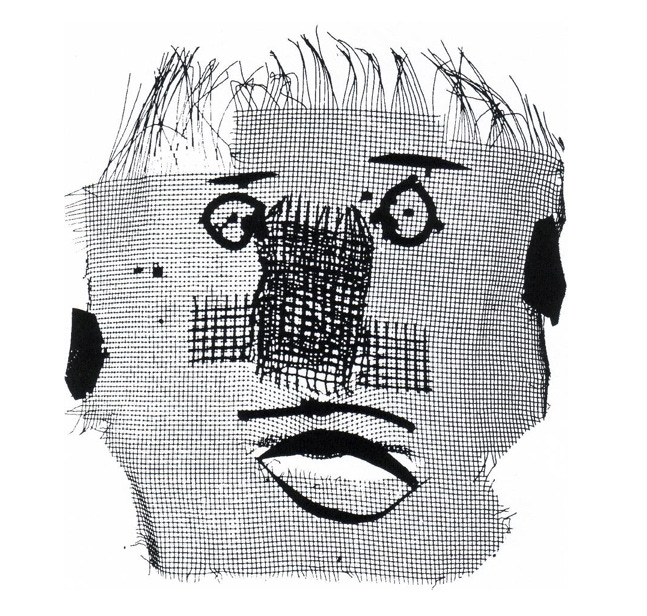
At the “art-school on a barge” a seven year old girl made this metal mask of mosquito wire, iron wire and pieces cut out of an old tin. To make the pupils of the eyes she very carefully melted some tin solder in place. “If I wear that mask, mosquitoes can’t bite my face,” she explained.
The aftermath of the war lasted for many years, and we had to help several kids from emotionally disturbed families through music therapy, long before we had ever heard of the word.
We saw results, especially when the youngsters could make their own simple drums and other rhythm instruments. Years and years later, in Auckland, 32 Karen and I did music therapy once more, in one-to one sessions with young adults. That time we were given the use of a Presbyterian Church building for our work, outside the hours when services were held.
During that period we also somehow got involved with Youthline. Once a week we went to Youthline House, sat on the floor or on some old couch with a great bunch of youngsters, played music for them and with them, sang our songs and listened to them read the poems they had written or sing their own songs. Music therapy was too big a word for those sessions, but somehow it did seem to help them.
Funny thing: Naomi learned counselling at a Youthline course shortly after, and eventually, in 2002, Gemma did the same! Karen had worked as Telephone Counsellor at Lifeline while we still lived in our house, and later followed further counselling courses at Carrington Technical Institute, where she got her certificates Counselling 1, 2 and 3 and Family Counselling in 1986 and '87.
The biggest challenge came when I had to give a ten-evenings refresher course to art teachers in the east of The Netherlands, to introduce the teaching methods we were developing. That was part of our UNESCO brief.
There I stood in front of a room full of experienced art teachers, telling them that they had been doing it all wrong, all those years they had been in the profession. I needed to convince them, so I took along some of the work my youngest students had made, working with very thin galvanized sheet iron and iron wire.
I showed the teachers the raw materials, and how to use soldering irons, and asked them to make iron flowers as homework. 'Iron flowers?' they said. 'Impossible. We're teachers, not mechanics.' Once more I showed them the work of my younger students: 'See this one? Isn't it beautiful? It was made by a six year old girl.'
A week later they showed me their work. 'We didn't think we could have done it. What's the next step?'
I thoroughly enjoyed teaching right from the start. We had one advantage over regular High School teachers: our students were there because they wanted to learn, not because they had to. And it was also more than a little helpful to have a regular income - as a student I had always been short of money.
In Amsterdam they have slot machines for fast food like meatballs or little cheese soufflés or sausage rolls, and on the way to my flat I was always tempted to stop off and spend 25 cents on something hot. Always tempted, but hardly ever could I spare the money. Even nowadays, when Karen and I stop somewhere for a cup of coffee, I'll have a sausage roll too.
'I noticed that the other day. I had chicken nibbles, but you wanted that big sausage roll. Did you take on other jobs too, Grandpa, like baby-sitting?' 'I sure did, Tracy. Anything at all. Like sleeping in the window of a big store on one of the main shopping streets in Amsterdam.
They wanted to advertise the beds they sold, and to be honest, it was one of the best beds I've ever slept in. The only problem was I had to stay in bed till after eight o'clock, so all the people could see me lying there on their way to work. And that meant I had to rush like crazy to get to the Academy in time for the nine o'clock lectures.
That's when I got into the habit of drinking a litre of buttermilk porridge as breakfast. Cheap, wholesome and above all, fast.
But the job I liked best was swimming around with a butterfly net to catch sea beasties. That was for a company in Amsterdam that embedded biological specimens in clear plastic to sell to 32 High Schools.
That season I had to swim around in the sea every Sunday with my diving gear and a very light net to catch whatever I saw swimming past. I had dozens of little jars attached to my belt to put my catch in, and when all the jars were full, I had to preserve my catch at home and take to their lab. They had set prices for the different crabs and fishes and various crawlies.
And even that experience came in handy later on when I worked at the Canterbury Museum. I can't think of anything that I did and learned in those days that I didn't use somehow later on.