

Saying Goodbye
AFSCHEID

Op 16 october j.l. scheepte de familie Cappel zich in op de Zuiderkruis op weg naar hun nieuwe vaderland Nieuw-Zeeland. Wij zullen de heer Leo Cappel missen op onze trainingsuren en vooral ook de artikelen die van zijn hand in ons O.J.C.-blad verschenen.
De heer Cappel was een kenner van de Noordzee bij uitstek en een pionier voor de onderwatersport in Nederland. Wij hopen dat het hem in zijn nieuwe vaderland voor de wind zal gaan en dat hij in zijn nieuwe omgeving weer de mogelijkheid zal vinden zijn oude liefde, de onderwatersport, op te nemen. Een stevige vlies van alle O.J.C.enaren.'
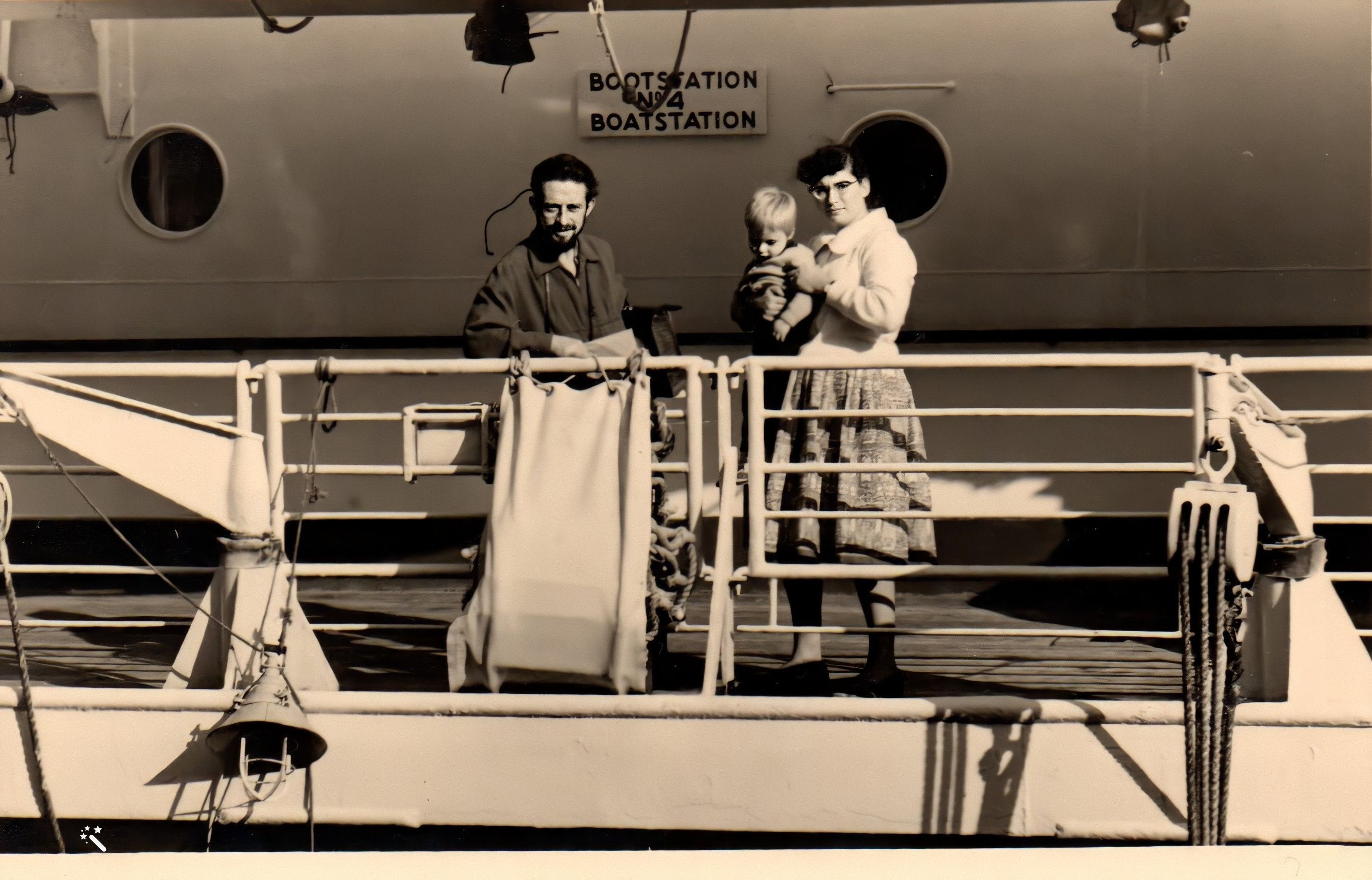
Literally translated: On the 16th October the family Cappel embarked on the Zuiderkruis on the way to their new homeland, New Zealand.
We will miss Mr. Leo Cappel at our training nights and especially also the articles he wrote which appeared in our O.J.C. magazine. The OJC was a Dutch scuba diving club.
Mr. Cappel was eminently well-informed about the North Sea and a pioneer for the underwater sport in the Netherlands. We hope he will prosper in his new homeland and that he will again find the opportunity in his new surroundings to take up his old love, the underwater sport. A firm flipper from all O.J.C .ers.
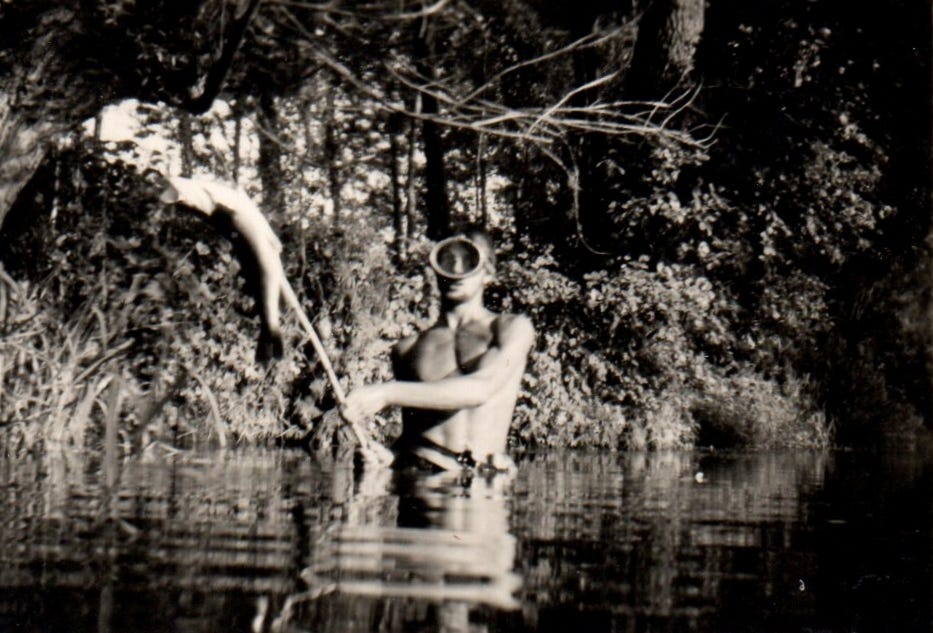
Sounds rather formal, doesn't it, and exaggerated, but that was the way we talked in Holland. At times we even shook hands when we met in the evening with other students to discuss what we had learned that day. All day we had been together in the lecture room, then at night we shook hands before sitting down.
When we emigrated we couldn't take my diving gear with us, we were only allowed a packing case of 2 ½ cubic metres, not enough to take much personal gear. All I had brought was my underwater camera, and that ended up eventually in the collection of the Auckland Museum.
But even if I could have taken everything, don't forget we were pretty well on our own. I had one friend here, Herman, who was our sponsor, but no family, nobody but ourselves.
We did make more friends, but I still didn't feel I could go diving and leave Karen and Luigi to cope on their own. I never got into scuba diving in New Zealand. Pity, as the diving waters here are far superior to the North Sea waters. No, it was the end of my diving. And it was the beginning of a totally different kind of life, a life of unknown freedom.
I gave up something, I got something in return. When we left The Netherlands we expected the bad times there to last forever: no future for Luigi, nowhere decent for him to live and grow up.
We were wrong. In 1960, no more than a year after we left, they discovered natural gas in The Netherlands. Enormous reserves. So the Dutch economy improved beyond recognition and financially they became more prosperous than New Zealand. But the quality of life and the freedom we had found here was never to be found over there.
And anyway, how could we have known? I'd rather not talk about the farewell to our family, it was too sad.
On 16 October 1959 we embarked on the emigrant carrier “Zuiderkruis” (Southern Cross”). Luigi was 2 years old by then.
The canvas arrangement hanging from the railing was a chute into the lifeboat underneath. The one-and-only life boat exercise was so confusing, that by the time we had dressed Luigi in his adult-sized life jacket and found out next to which lifeboat we had to assemble, roll call was well and truly over.
We came out on an emigrant ship, the Zuiderkruis. She carried no ordinary passengers, only a thousand or so emigrants. That first night we stood on deck as we steamed along the Dutch coast. A coastline I had seen before, on sailing trips with a few friends. But that time, seeing the disappearing coast in the light of the setting sun, was particularly poignant.
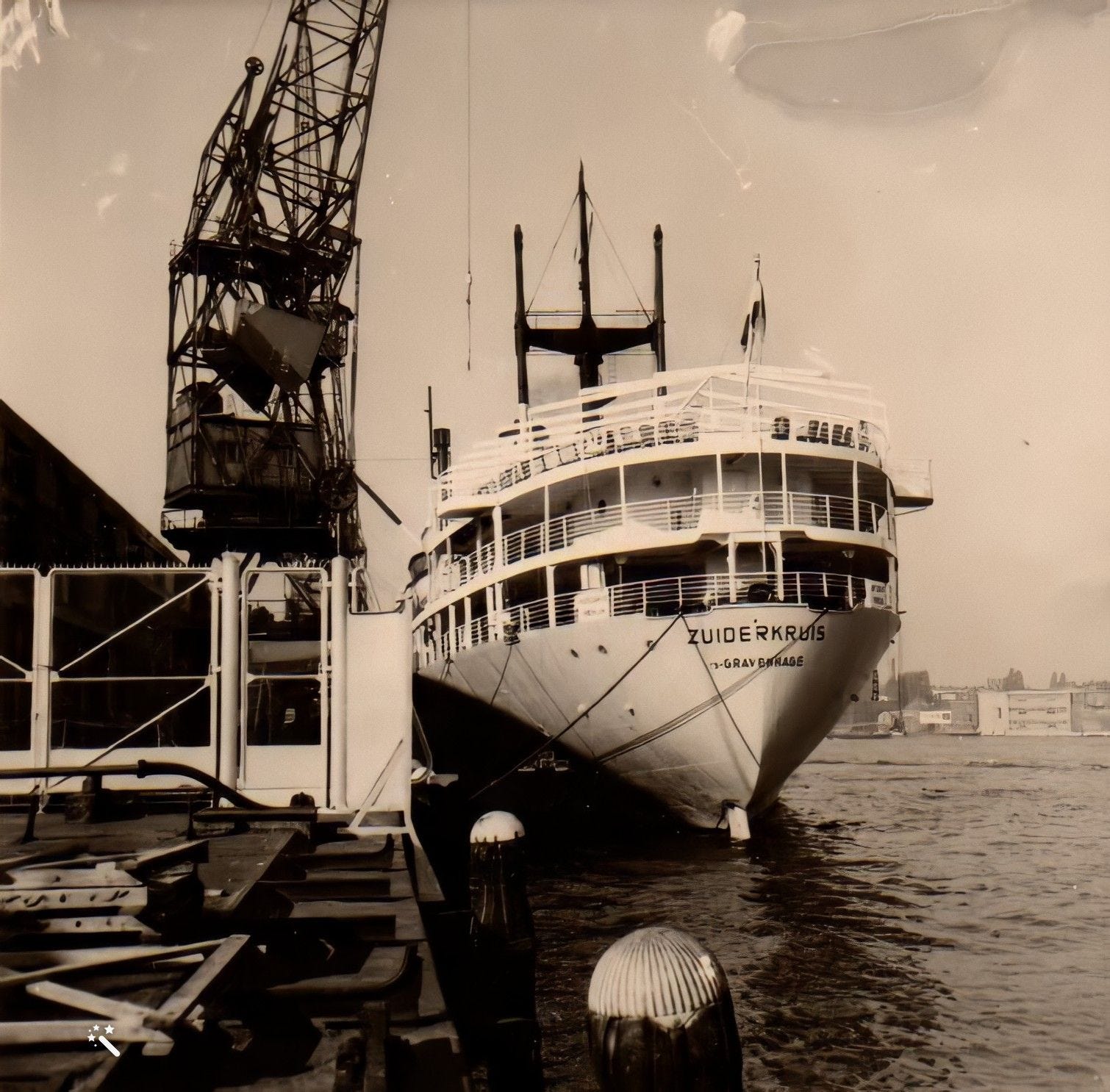
The Zuiderkruis had started life as a Victory Class Ship in 1944 in Port Oregon. In '47 the Dutch government acquired her, built on another deck and used her as troop carrier to Indonesia, and in '51 they added yet another deck, so she could be used as an emigrant ship by the shipping company N.V. Stoomvaart Maatschappij 'Nederland'. Her length was 139 metres, her beam 18.9 metre, and her tonnage 9376.
Not particularly big as ocean liners go, but we got to love her. We were on her last voyage ever, after that she became a temporary hospital in the harbour of Amsterdam, to help out with the shortage of buildings, any kind of buildings.
Not that everything was perfect: Karen and Luigi were put in a cabin amidships with five other women and children, right above the noisy main galley, and I slept in the very last cabin at the bottom deck with five other men, straight above the massive propeller. But we were young, and the whole voyage was supposed to take less than six weeks, so we didn't really mind.
Apart from a storm in the Bay of Biscay the first part of the trip was pleasantly uneventful. That storm was hectic though. The watertight doors were closed as the waves washed right up to the top deck. Most people were seasick, not so Karen and I. So, at mealtime, when we were offered sandwiches with a small side dish of Indonesian food, we gorged ourselves on the side dishes only.
Two-year-old Luigi was not so lucky: the children were not allowed to eat with the adults – after all, we were only emigrants – and had to stay in the nursery. Children screaming, rolling around on the heaving floor and vomiting on each other. And nothing Karen and I could do about it. Rules were rules, the crew told us.
Two days later everything was serene again. We sat on deck for hours, watching the pale blue wake and the flying fish, speculating what we would find in New Zealand, and getting nicely suntanned.
Our first stop, Curaçao, worked out better for us than for anybody else on board. A friend of ours had been stationed for six months on the island. He was a geologist and had to do some government research. So as soon as we docked, we walked ashore and hitchhiked to his home. Or tried to. A police officer stopped us: 'You're in South America now, you can't take that kind of risk!' he told us, and he gave us a ride to our friend's place.
In the meantime a long, long line of dockworkers began to off-load meat. Whole pig carcasses, half cows, and sheep, all covered in green mould. The main freezer had broken down and would take several days to repair. The emigrants and all the crew had to swelter: while the freezer was being rebuilt, the air conditioning and ventilation systems had to be closed down.
Karen and I had a marvellous time though. Snorkelling between the tropical corals, being driven all over the island and window-shopping in the town, Willemstad. We were lucky all right.
The next port of call was Balboa, at the other end of the Panama Canal. Unfortunately the price of drinking water in Balboa had gone up so much that the company decided we would have to do with what we had on board. Showers and fresh water taps were closed, except for one hour early in the morning. To save water we no longer got clean bedding either, we just slept on the bare mattresses. Not that that mattered a great deal, it was warm enough.
Some people began to grumble though, and one crewmember got badly burned when one of the steam pipes in the engine room burst and there was no cold water on tap for his burns. It wasn't long before there was an outbreak of some dysentery-like illness. Just about everyone caught it and the only medicine we were given was jug after jug of cold tea to drink. No food whatsoever, just cold tea. But the tea seemed to do the job and a couple of days later shipboard life had returned to normal.
Except for one morning when the ship's engines broke down and we drifted around for the rest of the day until they were fixed again. The captain tried to catch sharks with a hunk of meat on a long rope, no luck, there wasn't a shark in sight, just flying fish.
The last stop was Tahiti. Everything just as the travelogues in Holland had promised: pleasant and warm and the seawater was nice and clear. Early the next morning we sailed out again. Just a happy memory, a short interlude before getting to New Zealand.
Arriving in a new country was exciting. No thoughts of what we had left behind, and no war memories at all that morning. We steamed into Wellington harbour at daybreak, as beautiful a morning as we had ever seen. No wind, no clouds, just smooth water and hillsides with little coloured houses in between the trees. Much more beautiful than we had ever imagined. It felt like a promise.
We should have gone down to our cabins to pack our hand luggage, but we couldn't get away from the railing until we were tied up alongside the wharf and they had started to unload our suitcases out of the main hold. When we finally rushed down we didn't get any further than the main foyer.
They had just put the gangplank to the shore in place when a Dutch couple came aboard. 'We're looking for Leo and Karen Cappèl,' we heard the man say. 'You're joking, that's us! You want us?' The very first people to come aboard were looking for us. And they bumped into us straight away. Out of a ship full of emigrants. We found it hard to believe, but as I told you before, our lives were always full of coincidences.
It turned out the man was the half-brother of a friend of us in Holland, and he came to take us out for lunch. I suppose we should have asked permission, but we didn't, we were far too excited. We didn't even go down to our cabins for our gear, 'We'll do that when we get back,' we thought.
So, we walked ashore with Luigi on my shoulders, and the man loaded us into a funny old car. 'We thought we'll take you to a little river we know and we can have lunch there. Just for an hour or so.' 'Is that the New Zealand way? Fine with us,' we said.
I have no idea just where they took us. It was a fast flowing river with grassy banks about an hour's drive outside Wellington, ideal for a picnic. But that's all I know. We probably spent more time there than we should have, but it was our first taste of the New Zealand landscape, and it was so idyllic we couldn't get enough of it.
Our new friend had told us not to worry, he'd get us back aboard the Zuiderkruis in plenty of time. It didn't work out that way though. Little Luigi was used to the movement of an ocean cruiser, not to that of an old car on a winding road, so he got thoroughly carsick on the way back.
Time and time again he had to walk alongside the car, while our friend kept going in first gear. Then, to top it off, we got a flat tire no more than half an hour out of Wellington. Not a very good spare either, but with regular pumping we could use it. Slow, slow, slow.
Back on board we found everyone in a blind panic: we were due to sail in minutes on the Maori - the inter-island ferry to Christchurch - and we were missing!
Meanwhile the officers on the Zuiderkruis had radioed to hold the Maori until we were found. We rushed down to our cabins to throw our hand luggage together, and ran back to the foyer. Our suitcases were sitting unopened in front of the closed customs shed, and the customs officers had gone home without ever looking at our stuff.
Back into our friend's car and on to the Maori. The Maori sailed as soon as we were on board and early the next morning we sailed into Lyttelton Harbour. Again, beautiful hillsides scattered with colourful little houses. We got to love New Zealand straight away. It was spring, the year was 1959, and life promised to be good.